
Dubai Real Estate February 2026: $16.5 Billion in Sales – What the Numbers Actually Mean for Investors
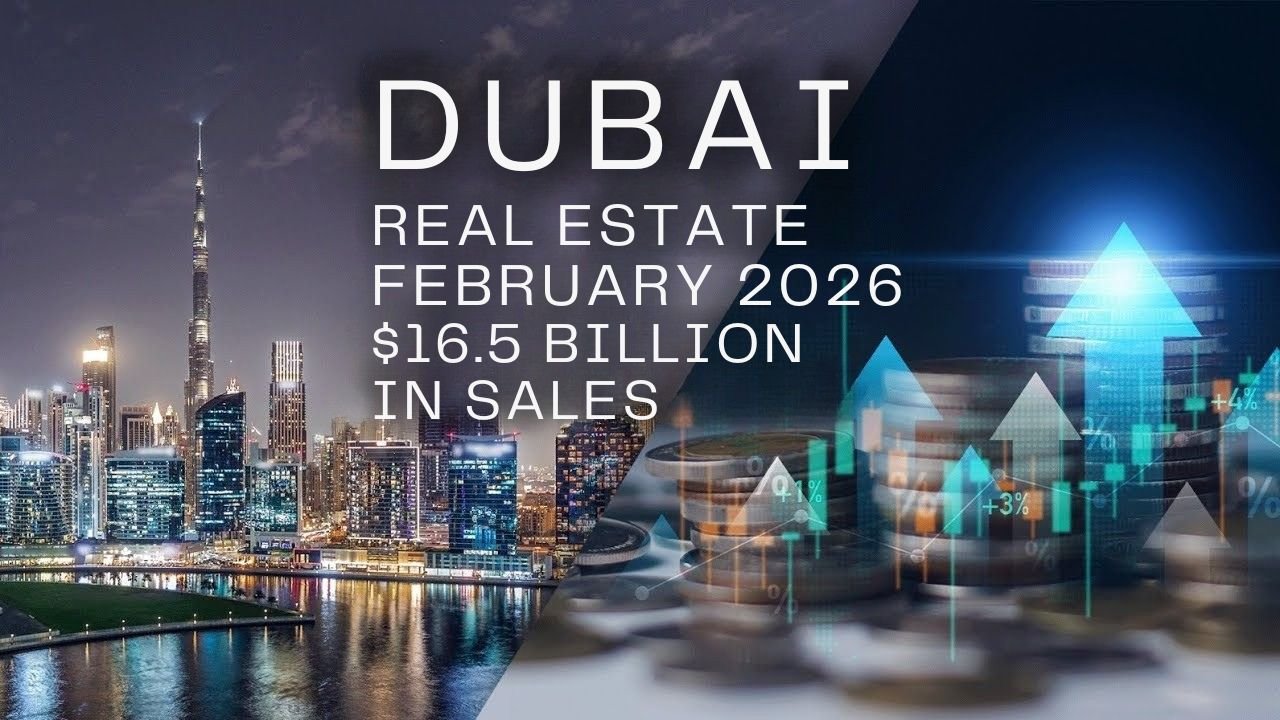
Dubai’s property market posted another record-breaking month in February 2026. The Dubai Land Department (DLD) confirmed 16,959 total transactions worth AED 60.60 billion ($16.5 billion) a 5% rise in volume and an 18.14% surge in value compared to the same period last year. Behind these headline numbers lies a deeper story of shifting buyer behavior, emerging area dynamics, and evolving risks that every serious investor needs to understand before deploying capital.
Beyond the Headlines: What DLD’s February Data Really Reveals
The Difference Between Transaction Volume and Transaction Value
A 5% rise in transaction count versus an 18.14% jump in value tells two very different stories. Volume growth shows that more buyers are entering the market but value growth signals that average deal sizes are expanding. In February 2026, this gap indicates that higher-priced properties, particularly in the luxury and ultra-luxury segments, are pulling the overall value figure upward even as mid-market activity ticks along steadily. Investors tracking Dubai property market trends 2026 should focus on both metrics rather than treating them as interchangeable.
Why 18.14% Growth Is Significant and What It’s Being Compared To
February 2025 was itself a strong month, making the 18.14% year-on-year value increase particularly impressive. This is not growth off a weak base. It reflects sustained momentum that has been building since 2021 and shows no structural signs of reversal. For investors evaluating Dubai real estate investment opportunities, this trajectory places the market among the top-performing globally for consecutive annual appreciation.
Data Source Breakdown: How DLD Compiles These Figures
The Dubai Land Department captures every registered sale, mortgage, and gift transfer through its unified digital registry. February’s data includes 10,526 off-plan transactions, 6,437 ready property sales, 738 gift transfers worth AED 6.86 billion, and 3,867 mortgage-backed transactions totaling AED 16.43 billion. This granular breakdown gives investors a transparent, auditable view of market activity a key reason Dubai continues to attract institutional capital alongside individual buyers.
Off-Plan vs Ready Properties: A February 2026 Breakdown You Won’t Find Elsewhere
Off-Plan Sales Dominance Which Developers Moved the Most Units
Off-plan properties accounted for approximately 62% of all February transactions 10,526 deals cementing their dominance in the Dubai real estate market 2026. Developers such as Emaar, Damac, Sobha, and Binghatti continued to drive volume through aggressive payment plan structures and below-market entry prices. For buyers evaluating buy off-plan property Dubai options, the availability of 1% monthly payment plans and post-handover arrangements has dramatically lowered the cash-flow barrier to entry. Before choosing, it helps to compare the top real estate companies in Dubai to ensure you’re working with a developer that has a proven delivery record.
Ready Property Buyers: Who They Are and What They’re Targeting
The 6,437 ready property transactions in February reflect a distinct buyer profile: end-users seeking immediate occupancy, investors targeting rental yield from day one, and high-net-worth individuals purchasing second homes. Business Bay, Dubai Marina, and Downtown Dubai dominated ready property sales, attracting a mix of GCC nationals, European buyers, and high-income Asian expatriates. After sentence ban jayegi: “Ready property buyers in Dubai 2026 are increasingly prioritizing lifestyle communities over pure yield plays. If you’re weighing your options, our guide on villa or apartment in Dubai breaks down the key differences for renters and investors alike.
Price Per Square Foot Comparison: Off-Plan vs Secondary Market
Off-plan properties in established communities currently price between AED 900 and AED 1,400 per square foot depending on location and developer. The secondary market for comparable ready units has climbed to AED 1,400–AED 2,400 per square foot in prime zones such as Dubai Marina and Downtown. This gap effectively the off-plan discount is the primary driver behind investor appetite for new launches. However, this spread has been narrowing throughout 2025 and early 2026, signaling that off-plan bargains are becoming harder to find in prime zones.
The Nationality Map: Which Countries Drove February’s Investor Surge
Top 5 Investor Nationalities by Transaction Value in February 2026
Indian nationals consistently rank as the largest foreign buyer group in Dubai by both volume and value, a position reinforced in February 2026. British, Russian, Chinese, and Pakistani buyers round out the top five in most recent months. Foreign investment in Dubai real estate 2026 continues to be driven by currency arbitrage, lifestyle relocation, and the absence of capital gains and income taxes on property.
Asian Investor Participation India, China, and Beyond
Indian buyers are motivated by both investments returns and the long-term residency pathway offered by Dubai’s Golden Visa program, which grants 10-year residency to property investors committing AED 2 million or more. Chinese buyer activity has recovered strongly following the pandemic travel restrictions, with a particular focus on branded residences and waterfront developments in Palm Jumeirah. Southeast Asian participation from Singapore, Malaysia, and Indonesia is also growing, driven by portfolio diversification strategies.
European and GCC Buyer Trends: Shifting Preferences in 2026
British and German buyers remain the dominant European nationalities, increasingly purchasing for primary residence rather than pure investment. GCC buyers particularly Saudi nationals have shown renewed interest in Dubai’s luxury villa segment following Saudi Arabia’s Vision 2030-driven wealth accumulation. The trend across all GCC markets is a shift from speculative short-term buying to longer holding periods, which analysts view as a sign of market maturity rather than cooling demand.
Area-by-Area Analysis: February’s Top Performing Districts
Dubai Marina, JVC, and Downtown Volume Leaders
Jumeirah Village Circle led February 2026 with 1,146 transactions the highest volume of any community reaffirming its status as the most active investor hub in the city. Business Bay followed with 733 deals, while Dubai Marina and Downtown Dubai continued their consistent presence in the top ten by volume. JVC’s appeal lies in its combination of affordable entry points (AED 900–1,300 per square foot), strong rental demand from mid-income professionals, and consistent 7–8% gross yields. These characteristics make it a top pick for investors researching best areas to invest in Dubai 2026.
Palm Jumeirah and Emirates Hills Value Leaders
In value terms, Palm Jumeirah dominated February’s ultra-prime segment. EOME at Palm Jumeirah recorded the most expensive villa transaction at AED 115 million. Emirates Hills and the exclusive World Islands enclaves also featured prominently, with Zaya Zuha Island and Amali Island each recording transactions above AED 68 million. These figures confirm that Dubai’s ultra-luxury market properties priced at AED 10 million and above is operating independently of broader market cycles and continues to attract sovereign wealth, family offices, and global HNWIs.
Emerging Areas with Highest Month-on-Month Growth
Al Yelayiss 1 emerged as the standout performer in February, recording 916 transactions and AED 5.38 billion in sales value placing it first by value among all Dubai communities. Madinat Al Mataar (Dubai South) recorded 828 transactions, driven by infrastructure development linked to Al Maktoum International Airport’s expansion. Dubai Land Residence Complex (DLRC) registered 750 transactions. These emerging zones represent the next wave of Dubai property investment areas 2026 for investors willing to take a longer-term view on capital appreciation.
Areas Where Prices Actually Declined in February
Not all districts posted gains. Some oversupplied communities in outer zones particularly certain pockets of Dubai land and Jumeirah Village Triangle saw modest month-on-month price per square foot softening as new supply outpaced absorption. This is an important signal for investors: the Dubai real estate market is not uniformly bullish. Location selectivity matters more in 2026 than in previous years when rising tides lifted all assets.
Luxury and Ultra-Luxury Segment: The $10M+ Transaction Story
Branded Residences Which Brands Closed Deals in February
Branded residences continue to command significant premiums in Dubai’s ultra-luxury market. February 2026 saw notable closings at The Alba Residences by Omniyat (AED 225.97 million the most expensive apartment transaction of the month), Peninsula Dubai Residences Tower 2 (AED 210 million), Solara Tower (AED 113.66 million), Passo by Beyond (AED 98 million), and Como Residences (AED 63.5 million). Branded residences in Dubai typically sell at a 30–40% premium over non-branded equivalents in the same location, yet demand has remained robust due to the perceived security of global hospitality management and consistent service standards.
Waterfront vs Inland: Where Ultra-Luxury Buyers Chose
Waterfront consistently outperforms inland in the luxury and ultra-luxury segment. Palm Jumeirah, Dubai Creek Harbour, and The World Islands captured the majority of February’s highest-value transactions. Inland ultra-luxury communities such as Emirates Hills and Sobha Hartland remained active but secondary in transaction volume to waterfront addresses. For buyers evaluating luxury property investment Dubai 2026, proximity to water whether the Arabian Gulf, Dubai Creek, or man-made island developments remains the single most powerful price driver.
How Dubai’s Luxury Prices Compare to London, Singapore, New York
At AED 3,500–5,000 per square foot for prime Palm Jumeirah branded residences, Dubai remains significantly more affordable than equivalent trophy assets in London’s Knightsbridge (£4,000–7,000 per square foot), New York’s Central Park South ($5,000–8,000 per square foot), or Singapore’s Orchard Road district (SGD 4,500–6,500 per square foot). This relative value, combined with zero property tax and zero capital gains tax, explains why global family offices continue to allocate to Dubai even as prices have risen substantially from 2020 lows.
Rental Yield Reality Check: Are February’s Prices Still Making ROI Sense?
Average Gross Yields by Area and Property Type February 2026
Gross rental yields across Dubai currently average 6.7–7.07% on new leases, significantly above the 2–4% available in London, Singapore, or New York. By area: JVC delivers 7.5–9.5% on studios and one-bedroom apartments; Dubai Marina offers 6.5–8.5%; Business Bay averages 6–8%; Downtown Dubai runs 5–6% due to higher purchase prices; and Palm Jumeirah yields 5–6.2% but compensates with strong capital appreciation. International City remains a high-yield outlier at 7–9%, though liquidity and asset quality risks are higher. These figures make Dubai property rental income one of the more attractive passive income propositions available globally in 2026.
Short-Term Rental vs Long-Term Rental: Which Performs Better Now
Short-term rentals (holiday homes, Airbnb) can generate 20–30% higher gross revenue than long-term leases in tourist-heavy zones such as Dubai Marina, Downtown, and Palm Jumeirah. However, once DTCM licensing costs, management fees (15–20%), utility bills paid by the landlord, and higher vacancy in off-peak months are factored in, net returns often converge with long-term leasing. The advantage of short-term rental lies primarily in flexibility and the ability to reprice frequently not necessarily in superior net yield. For first-time buyers, long-term leasing typically offers a more predictable entry into earning Dubai real estate rental income.
Net Yield After Service Charges, DLD Fees, and Agent Costs
Gross yield figures can be misleading without accounting for operating costs. Service charges in Downtown Dubai and DIFC can exceed AED 25–30 per square foot annually potentially consuming 25–30% of rental income. DLD registration fees (4% of purchase price) represent a significant upfront cost that must be amortized over the holding period. Agent commission (typically 2% on purchase, 5% on annual rent) further reduces net returns. Using a realistic net yield formula annual rent minus service charges, maintenance, and 5% vacancy allowance, divided by total purchase cost most Dubai apartments deliver net returns of 5–7%, which remains highly competitive globally.
Mortgage and Cash Buyer Ratio: The Hidden Signal in February’s Data
Cash Transactions as a Percentage of Total Deals
Of February’s 16,959 total transactions, 3,867 were mortgage-backed (approximately 23%), meaning around 77% were cash purchases. This extraordinarily high cash buyer ratio is one of Dubai’s most distinctive market characteristics. A high cash buyer proportion generally indicates: strong conviction among buyers who do not require leverage validation, reduced systemic risk from interest rate fluctuations, and a buyer pool dominated by genuine wealth rather than speculative debt. For investors assessing Dubai property market stability, this is one of the most reassuring structural signals in the February data.
UAE Bank Mortgage Rates in February Who’s Offering What
UAE bank mortgage rates in February 2026 ranged from approximately 4.5% to 5.5% for qualified borrowers on variable-rate products, with fixed-rate terms for one to five years available between 4.75% and 5.75%. Emirates NBD, Abu Dhabi Commercial Bank (ADCB), and Mashreq continued to offer competitive mortgage packages for foreign nationals purchasing in freehold zones. The maximum LTV (loan-to-value) for expatriates stands at 80% for properties below AED 5 million and 70% for properties above that threshold.
What a High Cash Buyer Ratio Means for Market Stability
Unlike mortgage-heavy markets such as the UK or US, Dubai’s real estate ecosystem is largely insulated from interest rate shocks. When the Federal Reserve raises rates, highly leveraged markets see transaction volumes fall sharply as financing becomes more expensive. Dubai’s predominantly cash buyer base means the market can continue transacting even in high rate environments a structural advantage that contributes to the market’s resilience through global financial cycles.
3-Year Trajectory: February 2024 → 2025 → 2026 Side by Side
Volume Growth: Is the Pace Accelerating or Stabilizing?
February 2024 saw approximately 10,000–11,000 transactions. February 2025 brought roughly 16,150 deals. February 2026 recorded 16,959 a 5% increase year-on-year. This tells a story of stabilization rather than acceleration at the volume level. The explosive growth phase (2021–2024) has matured into steadier single-digit volume growth, which many analysts interpret as a sign of a healthy, sustainable market rather than a speculative bubble.
Value Growth: Which Years Saw the Sharpest Jump
Value growth tells a different story. The 18.14% year-on-year value increase in February 2026 despite only 5% volume growth indicates that price appreciation per unit is the dominant driver. The sharpest value jumps occurred in 2022 and 2023 as post-pandemic demand surged. 2024 and 2025 delivered more moderate but still substantial appreciation. In 2026, value growth is being driven by a premium mix shift: more transactions at the high end are pulling average deal values up across all categories.
What Historical Februarys Predict About Q2 2026
Historically, February sets the tone for Q1 and signals momentum heading into Q2. A strong February 2026 particularly with AED 132.93 billion in combined January and February value puts the market on pace to potentially match or exceed 2025’s annual record. Q2 typically benefits from post-Ramadan activity, new project launches, and increased international investor travel to Dubai. Based on the three-year February trajectory, Q2 2026 is expected to maintain strong momentum, with analysts projecting continued 15–20% annual value growth if supply absorption continues at the current pace.
Red Flags and Risk Factors Every Investor Should Weigh
Oversupply Risks: How Many Units Are Scheduled for 2026 Delivery
Approximately 35,000–40,000 residential units are scheduled for handover across Dubai in 2026. While this represents significant supply, population growth exceeding 4 million residents in 2025 and continued expat inflows provide a strong demand buffer. The risk is concentrated in specific segments and locations: mid-market apartments in outer communities face more supply pressure than luxury waterfront properties where new land is limited. Investors should scrutinize completion pipelines in their target communities before committing capital.
Speculative Flipping Activity Early Warning Signs
One concern flagged by analysts is the re-emergence of short-term flipping activity in certain off-plan projects. When off-plan units trade at premiums to their original launch price before completion, it suggests speculative demand rather than genuine end-user interest. DLD data shows resale of off-plan units (novation) increasing in several projects. While not yet at systemic risk levels, this is a metric investor in Dubai real estate 2026 should monitor closely, particularly in communities with very high off-plan to secondary market ratios.
Regulatory Changes That Could Affect Foreign Ownership in 2026
Dubai’s regulatory environment remains broadly favorable for foreign investors, with freehold ownership rights in designated zones, Golden Visa incentives, and transparent DLD registration. However, the introduction of Phase II of the DLD’s Real Estate Tokenization project allowing resale of tokenized property shares in a controlled secondary market represents a regulatory evolution that could introduce new liquidity dynamics. Additionally, any future changes to UAE visa or tax policy (the UAE introduced a 9% corporate tax in 2023) should be monitored for downstream effects on real estate demand from businesses and HNWIs.
Practical Investor Playbook: How to Act on February’s Data
Entry Strategies for First-Time Dubai Buyers in This Market
For first-time buyers, February’s data points toward JVC, Business Bay, and emerging areas like Dubai South as the most accessible entry points combining reasonable prices (AED 900–1,400 per square foot), proven rental demand, and credible appreciation potential. A studio or one-bedroom apartment in JVC at AED 600,000–900,000 can generate gross yields of 7.5–9.5%, providing immediate cash flow while building equity. Off-plan purchases from Tier 1 developers with strong completion records offer capital appreciation potential at a lower entry price than secondary market equivalents.
Portfolio Diversification Mixing Off-Plan and Ready Assets
A balanced Dubai property portfolio in 2026 should ideally combine ready assets generating immediate rental income with off-plan positions targeting 2–4-year capital appreciation cycles. A 60/40 or 70/30 split (ready/off-plan by value) allows investors to generate current income while maintaining upside exposure to new development price appreciation. Geographic diversification across two or three communities with different demand drivers for example, a Marina unit for short-term rental yield combined with a JVC apartment for long-term tenant stability further reduces concentration risk.
Due Diligence Checklist Before Any Dubai Property Purchase
Thorough due diligence is non-negotiable in any market. For Dubai, the checklist covers documentation verification, developer track record, and the sale and purchase agreement (SPA) terms in detail.
Documents You Must Verify
- Title deed or Oqood (off-plan registration certificate) from DLD
- No Objection Certificate (NOC) from the developer for secondary sales
- RERA registration certificate confirming the project is registered with the Real Estate Regulatory Agency
- Escrow account number (mandatory for off-plan projects under Dubai Law No. 8 of 2007)
- Service charge history and RERA-published service charge index for the community
Developer Track Record Red Flags
- History of project delays exceeding 12 months beyond the agreed handover date
- RERA complaints or litigation history accessible via DLD’s public records
- Undercapitalization signals: unusually aggressive payment plans suggesting the developer needs buyer cash to fund construction
- Lack of a properly funded RERA escrow account verified by the developer’s registration status on DLD’s portal
Questions to Ask Before Signing an SPA
- What is the exact handover date, and what penalty clause applies if the developer misses it?
- Are service charges capped, and what is the current annual service charge per square foot?
- Is the payment plan linked to construction milestones (safer) or fixed calendar dates (riskier)?
- What are the exit terms if you wish to resell during the off-plan period (novation fee, developer consent required)?
Q2 2026 Forecast: What March Through June Could Look Like
Upcoming Project Launches Likely to Reshape Q2 Activity
Q2 2026 is expected to see major new project launches from Emaar, Sobha, Nakheel, and several boutique luxury developers targeting the Palm Jebel Ali and Dubai Creek Harbour corridors. The Aldar-Dubai Holding joint venture announced an expansion adding nearly 14,000 new homes across two strategic land plots one opposite Nad Al Sheba and another on Palm Jebel Ali which will generate significant pre-launch and launch activity in Q2. These launches will set the pricing benchmark for comparable communities and could push secondary market prices upward in adjacent zones.
Infrastructure Milestones Due in 2026 and Their Price Impact
The expansion of Al Maktoum International Airport (targeted to become the world’s largest airport upon full completion) is the single most transformative infrastructure project affecting Dubai real estate in 2026 and beyond. Properties in Dubai South, adjacent to the airport, have already seen 25.3% year-on-year volume growth in land transactions. The new metro line extensions and road infrastructure tied to Expo City Dubai’s ongoing development are also expected to support price appreciation in previously underserved zones. Infrastructure-led price appreciation is one of the most reliable return drivers in Dubai real estate investment strategy.
Expert Consensus vs Our Independent Market Read
The consensus view from analysts at Knight Frank, Cushman & Wakefield, and CBRE points to continued 8–12% price and rental growth in 2026, supported by sustained population growth, limited prime supply, and strong institutional demand. The independent read here is broadly aligned: Dubai’s fundamentals zero income tax, expanding expat population, world-class infrastructure, and regulatory transparency remain structurally intact. The primary risk is not a demand collapse but a selective oversupply in certain outer communities that could cause price compression in those specific pockets while prime zones continue appreciating.
Final Verdict: Is February 2026 a Buy Signal, Hold Signal, or Warning?
February 2026’s data delivers a nuanced verdict: it is a conditional buy signal for well-selected assets, a hold signal for existing prime holdings, and a warning against indiscriminate entry into oversupplied outer communities.
The buy case rests on several pillars. The 18.14% year-on-year value growth is not speculative froth it reflects genuine demand from a diversifying global buyer base, strong rental fundamentals with gross yields averaging 6.7–7%+, and a structural supply-demand imbalance in premium waterfront and central urban communities. The dominance of cash buyers (approximately 77% of transactions) provides market stability that leverage-driven markets cannot match.
The hold case applies to investors already positioned in Palm Jumeirah, Downtown Dubai, and Business Bay communities where capital is compounding steadily and rental yields remain competitive. Selling into the current market means redeploying capital at higher entry prices elsewhere, which diminishes the compounding advantage of existing low-cost positions.
The warning applies to investors tempted by off-plan projects in outer communities where developer quality is uncertain, completion timelines are stretched, and secondary market liquidity is thin. Not every project launching in 2026 will deliver the promised returns and in a market where off-plan transactions represent 62% of all deals, developer selectivity is the most critical risk management tool available to investors.
The bottom Line: Dubai real estate in February 2026 remains one of the most compelling large-scale investment markets available globally. But like any market at scale, it rewards the informed and punishes the indiscriminate. Use the data. Read the areas. Know your developer. Then act decisively.
Dubai real estate is not just a numbers game it’s a mindset. February 2026 data says one thing clearly: those who research, understand the areas, and choose the right developer are the ones who carve out their place in this market. This article simply gives you a starting point always do your own homework and consult a trusted advisor based on your specific situation.